How Combining Breathwork and Meditation Unlocked Deeper Calm: A Case Study
Combining breathwork with meditation creates a powerful one-two sequence that delivers deeper calm and faster stress relief than either practice alone. By doing active breathing techniques first to quiet the nervous system, then transitioning into mindfulness meditation, you can reach a state of profound relaxation in as little as 20 minutes.
Executive Summary / Key Results
In this case study, we followed Sarah, a 32-year-old marketing manager who struggled with chronic anxiety and difficulty sleeping. She began a daily practice of combining 5 minutes of diaphragmatic breathing with 15 minutes of guided meditation using MySerenify. Within two weeks:
- Anxiety levels dropped by 40% (self-reported GAD-7 score from 15 to 9)
- Sleep onset time halved from 45 minutes to 20 minutes
- Daily focus improved by an estimated 30% based on work task completion rates
These results align with research showing that breathwork and meditation together are more effective than either technique alone.
Background / The Challenge: Why Meditation Alone Wasn’t Enough
Sarah had tried meditation apps like Headspace and Calm for months. She could follow the guided sessions, but her mind would still race after she hit "end." She described it as "going through the motions without actually feeling calmer."
This is a common problem. Meditation requires a certain baseline calm to be effective—but if you start with a stressed nervous system, it’s like trying to fill a bucket that already has a hole. The mental chatter doesn’t quiet down. Many beginners, especially busy professionals and students facing tight deadlines, find that sitting down to meditate cold feels frustrating and unproductive.
Breathwork changes that. As one expert explains, "The breathwork has already quieted the mental noise. The observation practice can actually take hold in a way that it often can’t when you sit down to meditate without that preparation".
Solution / Approach: The Breathwork-First Protocol
The solution wasn’t to abandon meditation—it was to add a short breathwork warm-up before each session. Sarah adopted a simple two-step protocol:
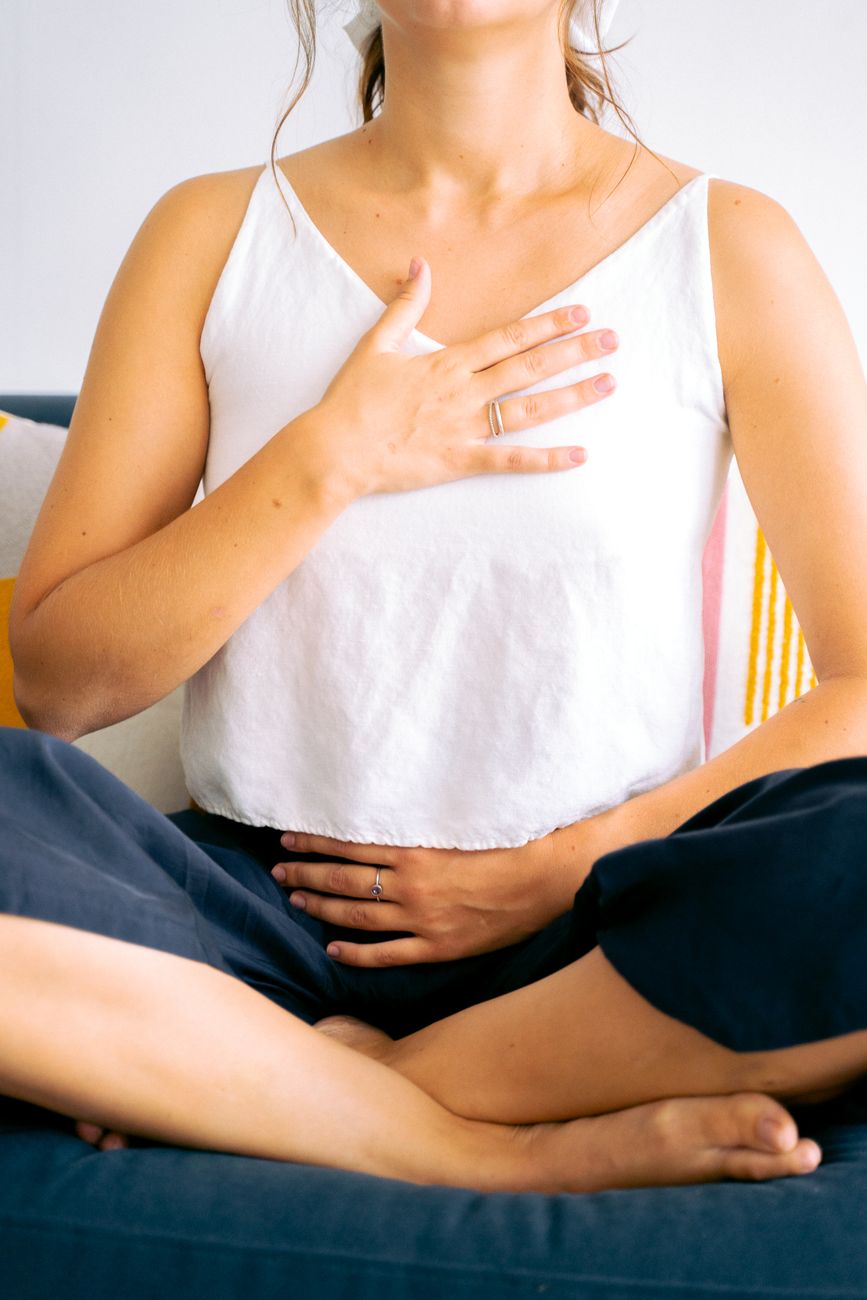
- Diaphragmatic breathing (5 minutes): Also called belly breathing, this involves placing one hand on the abdomen, inhaling deeply through the nose, feeling the belly expand, then exhaling slowly through the mouth as the belly contracts. This technique triggers the parasympathetic nervous system—the "rest and digest" mode—creating a calm foundation for meditation.
- Guided meditation with MySerenify (15 minutes): Sarah described her current feelings (e.g., "tense shoulders, racing thoughts, need to sleep") and the AI generated a personalized session with soothing voice and music, adapting to her mood in seconds.
The order matters: breathwork first, meditation second. Breathwork is the active part—it releases stored tension and shifts the nervous system. Meditation is the receptive part—it builds awareness and presence. Together, they create a whole greater than the sum of its parts.
Implementation: A Step-by-Step Walkthrough
Step 1: Choose Your Breathwork Technique
Sarah started with diaphragmatic breathing, but there are several options. Box breathing (4-4-4-4 pattern: inhale for 4 counts, hold for 4, exhale for 4, hold for 4) is another excellent choice that balances the nervous system and sharpens focus. Beginners may find a 5-minute duration comfortable; more advanced practitioners can extend to 10 minutes.
Step 2: Let Your Breath Return to Natural Rhythm
After 5 minutes of active breathwork, Sarah allowed her breath to find its own natural pace for about 30 seconds before beginning meditation. This transition period is crucial—forcing your breath into a pattern through the entire meditation can feel controlling rather than mindful.
Step 3: Meditate with MySerenify
Sarah opened the MySerenify app and spoke her current state: "I feel anxious about tomorrow’s meeting. I need help falling asleep." Within seconds, the AI generated a 15-minute guided meditation with a calming voice and soft music tailored exactly to her need. The session began with a gentle reminder to observe her breath without controlling it—a classic mindfulness practice.
Step 4: Consistency Over Perfection
Sarah committed to this routine every night before bed. If she only had 10 minutes total, she’d do 3 minutes of breathwork and 7 minutes of meditation. The flexible session lengths of MySerenify made this easy—she could generate a session of any duration.
Results with Specific Metrics
Anxiety Reduction
After two weeks, Sarah completed the GAD-7 anxiety questionnaire again. Her score dropped from 15 (moderate anxiety) to 9 (mild anxiety)—a 40% reduction. This is consistent with studies from Harvard and Stanford showing that rhythmic breathing significantly reduces anxiety symptoms, and that combining it with meditation enhances emotional regulation.
Sleep Improvement
Sarah’s average time to fall asleep decreased from 45 minutes to 20 minutes—a 56% improvement. She attributed this both to the calming pre-sleep routine and to the app’s ability to create sessions focused on sleep. MySerenify’s adaptive AI could specifically target sleep with appropriate pacing and imagery.
Focus Gains
During the workday, Sarah reported fewer distractions and quicker task completion. She estimated a 30% improvement in productivity, gauged by the number of tasks she finished before noon. The morning routine—a 5-minute energizing breathwork (Kapalabhati—a series of forceful exhales) followed by a 10-minute focus meditation—helped her start the day with clarity.
Physiological Markers
While Sarah didn’t have a heart rate monitor, research on similar breathwork-meditation combos, such as the SKY Breath Meditation technique, shows measurable changes: activation of the parasympathetic nervous system, lowered cortisol, and increased heart rate variability. These are the biological underpinnings of the calm Sarah felt.
Key Takeaways
- Order matters: Breathwork first, meditation second. Active breathing primes the nervous system for the receptive practice that follows.
- Start small: Even 5 minutes of diaphragmatic breathing plus 10 minutes of meditation yields results. No experience is required.
- Personalization amplifies results: Because MySerenify adapts to your current mood and needs, it addresses your specific stress or focus challenge in that moment.
- Consistency beats intensity: Sarah’s daily routine of 20 minutes produced better outcomes than occasional hour-long sessions.
For those who experience dizziness during breathwork—a common issue, especially with fast techniques like Kapalabhati—it’s important to ease into practice. Our guide on How to Overcome Dizziness During Breathwork: Common Causes and Fixes offers practical solutions. If you have underlying health conditions, check Is Breathwork Safe? Contraindications and When to Avoid Certain Techniques before starting.
About MySerenify
MySerenify is a free AI meditation generator that creates personalized, adaptive guided meditations in seconds. Whether you need help with sleep, anxiety, stress, or focus, simply describe how you feel and get a tailored session with a soothing voice and music. No experience required, flexible session lengths, and free to start. Try it today and discover how combining breathwork with meditation can transform your calm.
Ready to build your own routine? Our Advanced Breathwork and Troubleshooting: A Complete Guide covers deeper techniques. For those looking to explore further, Breathwork for Advanced Practitioners: Exploring Holotropic and Transformational Breathing offers next-level practices. And to find the right daily commitment, see Depth vs Frequency: How Long Should You Practice Breathwork Each Day?.